5 min read

Your Next Customer Isn’t Googling You. They’re Asking ChatGPT.

Your Next Customer Isn’t Googling You. They’re Asking ChatGPT.
9:21

Someone's remodeling their home. They open ChatGPT and type: "What's the best flooring for a kitchen?" The assistant gives them a quick answer. It explains the pros and cons of tile, vinyl, and hardwood. It mentions a few brands and links to some articles.

If your brand isn't in that answer, you're already behind. The first story the buyer hears about the market comes from an AI, not your website or showroom. That first impression shapes how they judge you later, even if they find you somewhere else.

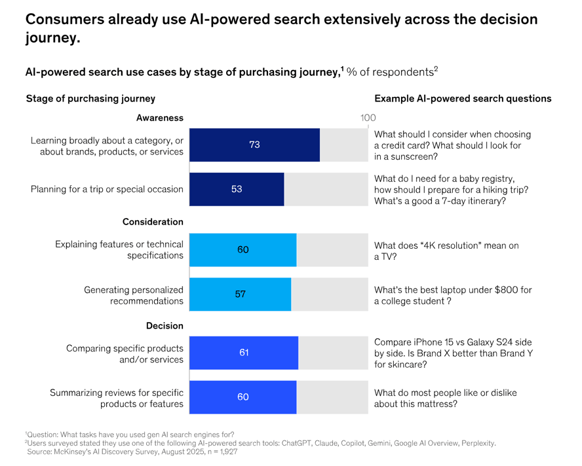
An image showing a research graph from McKinsey & Co that highlights AI-powered search use cases by stage of the purchasing journey

This is the shift. Search results used to show 10 blue links and some ads. A buyer could scan the page and click around. Now, many generative AI platforms just give one answer, a short list, or a quick explanation instead.

What generative engine optimization means

Generative engine optimization (GEO) is the practice of shaping what AI systems say about your brand, your category, and your competitors. It's about helping systems like ChatGPT, Gemini, and AI search results find, understand, and trust your content.

Traditional SEO focuses on ranking pages. GEO focuses on being cited and mentioned inside AI-generated answers. You still need strong SEO, but GEO builds on that and extends it into a world of AI summaries and recommendations.

Think of it this way. SEO is about getting into the room. GEO is about what people say about you when you're not in it.

Why this matters

Just recently, we were in a presentation with a prospect, and when I mentioned that many people find us through ChatGPT, the person who had first contacted us smiled and said, "Yeah, that's how I learned about you."

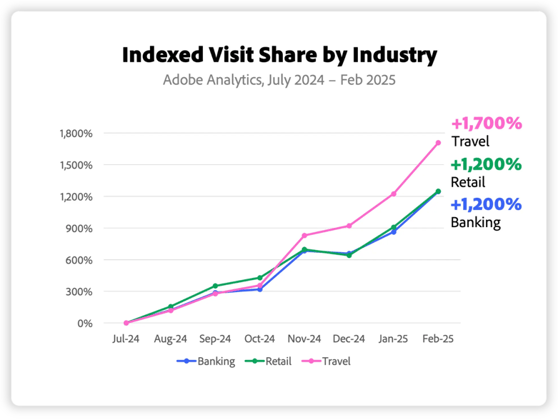
This is becoming increasingly common. For many buyers, AI assistants are now an early research step. In fact, research from Adobe Analytics shows that traffic to sites driven by generative AI has been doubling every two months since September 2024.

Chart from Adobe Analytics research showing the growth in AI-driven visit share by industry.

Buyers are asking AI platforms broad questions about options, common mistakes, and which brands to consider before they visit any sites. 

This creates risk and opportunity. If you're missing from these answers, you lose share of mind even if your performance marketing looks great. If you're present and positioned well, you can shape how the buyer thinks about you before they ever interact with your brand directly.

Research shows that a growing share of CMOs see GEO and AI-driven search as a top priority, but many lack clear metrics or ownership. That's a gap you can turn into an advantage with a simple plan.

How AI systems see and describe your brand

AI systems learn from massive training sets such as websites, news articles, Reddit threads, and more. When they answer a question, they draw on patterns in that training data as well as current sources they can access.

Your brand shows up in answers if:

  • Your content is clear, structured, and easy to read
  • You're cited or mentioned on trusted third-party sites
  • Your company, products, and experts are treated as distinct "entities" across the web

An entity is just something the model can recognize and understand as a specific thing. A company, a person, a product. Models don't think in pages. They think in entities and relationships. They connect your company to topics, problems, and audiences based on content, links, schema markup, reviews, bios, and other signals. If those signals are thin, messy, or inconsistent, the AI platform sees no reason to include you.

So what can you do about it? A few things.

Design content for the questions buyers ask AI

The first step is simple. Look at your category and list the exact questions a buyer types into AI. They usually sound like this:

  • "Best [category] for [use case]"
  • "[Brand A] vs [Brand B] for [application]"
  • "How much does [product] cost?"
  • "What should I look for in a [category]?"

The problem for marketers is that most sites don't answer these questions directly. The information is buried in long pages, gated PDFs, or brand-heavy messaging, and AI platforms favor sources that state the question clearly, give a straight answer, and then provide context.

To meet these requirements, your team can:

  • Create or revise pages to mirror these questions in headings and subheads
  • Put a short, clear summary answer at the top, then add detail below
  • Ensure you're using simple language and skipping the jargon
  • Be quotable. An AI model is more likely to pull a sentence that clearly answers a focused question than a vague marketing statement

Strengthen technical and structural signals

Generative engines rely on crawlers and structured signals, just as search engines do. If your content is hard to crawl, slow, or wrapped in complex scripts, models may not be able to see it well.

Key steps:

  • Keep your layouts clean. Don't hide key content behind scripts that block crawlers.
  • Use schema markup for products, articles, FAQs, organization, and people.
  • Make sure titles, meta descriptions, and headings reflect the real questions on the page.
  • Add transcripts for videos and podcasts so the text can be indexed.

These recommendations aren't really new. It's an extension of technical SEO. The difference is you're now optimizing for both ranking and how well models can read and reuse your content.

Build authority across the wider web

I'm going to use a dated reference here. Getting AI to recommend your brand is not a Field of Dreams situation.

A GIF from the movie Field of Dreams showing Kevin Costner's character walking through a field of corn while the on-screen text says, "If you build it, they will come."

AI systems don't rely on your website alone. They look at how often and in what context your brand appears elsewhere. The more places you show up (and the more trusted those places are), the more likely a model is to mention you.

This doesn't mean you need a team of thought leaders doing the podcast circuit. There are simpler ways to build authority:

  • Get more customer reviews on Google, Yelp, or industry-specific sites
  • Pursue mentions in roundup articles or "best of" lists
  • Get listed in directories and industry associations
  • Earn coverage in local press or trade publications
  • Create case studies, even simple ones, and get them placed on partner sites
  • If you do have experts on your team, encourage them to publish or speak in focused topic areas

The goal is consistency. Keep your company name, descriptions, and focus areas consistent across platforms so models can connect the dots. When your brand is tied to a topic in multiple sources, AI systems are more likely to reference you when someone asks about that topic.

Monitor your AI visibility

You can't manage what you never see. There are tools that offer AI visibility overviews, like SEMrush; however, a simple internal measurement can show you how visible you are in AI answers today.

Pick a short list of high-value prompts:

  • "Best [your category] for [use case]"
  • "What is [category] and who are the leading brands?"
  • "[Your brand] vs [key competitor]"
  • "Is [your brand] good for [application]?"

Test these in ChatGPT, Gemini, and AI search experiences. Take screenshots. Note which brands appear, which sources are cited, and how your brand is described (if at all).

Share the results internally. Treat this like an early warning system and idea source for content, PR, and product marketing. If certain content types or third-party sites keep showing up, figure out how to earn your way into those same places.

Define GEO metrics that matter

Measurement for GEO is still early. But you can start with practical signals. You don't need a perfect model to make progress.

Here are some useful metrics to monitor:

  • Presence: How often your brand appears in AI answers for a fixed list of prompts
  • Citation share: How often your site or content is cited relative to competitors
  • Sentiment and positioning: Whether descriptions match your intended narrative
  • Downstream impact: Changes in branded search, direct traffic, and qualified leads that align with GEO efforts over time

A 90-Day GEO Attack Plan

GEO touches SEO, content, brand, product marketing, and PR. In many companies, it makes sense to give operational ownership to the SEO or content team, with clear sponsorship from the CMO.

A simple 90-day plan:

Audit what AI says about you. Run a set of standard prompts in major assistants. Capture how your category, your brand, and your competitors are described.

Identify gaps and quick wins. List key questions where you don't appear or are framed poorly. Map these to content updates, new pages, and external placement opportunities.

Pilot GEO improvements on a narrow scope. Pick a small set of high-value topics or product lines. Update pages for answer-first structure, add schema, and pursue at least a few third-party mentions or reviews.

Re-test and share results with leadership. Repeat your prompts after changes. Note any shifts in presence, citations, or language. Use these early signals to align your C-suite on a broader GEO roadmap tied to brand, demand, and revenue goals.

Your buyers are already asking AI tools to tell them what matters, who to trust, and which brands to consider. GEO is how you make sure those tools know your story and can explain it clearly when it counts.


Wondering where your brand stands? Contact us for a GEO audit and a clear roadmap forward.

What Is Digital Marketing, Anyway?

What Is Digital Marketing, Anyway?

Recently, we had an introduction call with a prospective client, and they asked us: "what is digital marketing, anyway?" It’s honestly not a question...

Read More
How to Perform a Test of Your Marketing

How to Perform a Test of Your Marketing

Does any of the following sound familiar?

Read More
How to Build and Optimize Your Google My Business Listing

How to Build and Optimize Your Google My Business Listing

Google My Business tends to fly under the radar a bit in terms of its importance in your digital strategy. However, whether you're a small brand or a...

Read More