Why Most Digital Marketing Falls Apart
Most companies don't have a digital marketing strategy. They have a to-do list.
They run Facebook ads. They post on LinkedIn. They update their website every few months. Someone writes a blog post when there's time. The SEO agency sends a report nobody reads. The PPC team optimizes for clicks. And somehow, despite all this activity, nobody can answer the question that matters: Is any of this actually working?
Here's the pattern we see with mid-market companies. Marketing runs dozens of campaigns across multiple channels. Finance asks for proof that it's generating revenue. Marketing produces a dashboard with impressions, clicks, and engagement rates. Finance remains unconvinced. The budget conversation becomes a fight rather than a partnership toward a common goal.
The problem isn't that digital marketing doesn't work. It's that most companies build their marketing backwards. They start with tactics and tools instead of strategy and measurement. They buy software before they know what they're trying to accomplish. They hire specialists before they've defined success.
And now there's a new complication. The way people find information is changing. AI-powered search, from ChatGPT to Google's AI Overviews, is reshaping how buyers research and make decisions. If your content doesn't show up in these new answer engines, you have a visibility problem that traditional SEO won't fix.
This guide is for CMOs and marketing leaders who want to build a digital marketing system that actually works. Not just activity, but results. Not just metrics, but measurements your CFO and board will trust. Not just tactics, but a strategy that connects to business outcomes.
We'll cover the complete framework: how to build strategy before tactics, how to understand your customer journey, how to think about paid and organic channels, how to prepare for AI search, and how to set up measurement that proves marketing creates value.
Fair warning: some of this is hard. There's no silver bullet, and it won’t happen overnight. What works for one companywon't work for another. But there is a framework, and if you follow it, you'll be ahead of most of your competitors.

The Digital Marketing Strategy Framework
Strategy is not a list of things you're going to do. Strategy is a set of choices about where to play and how to win. Before you select channels or create marketing campaigns, you need to answer fundamental questions about your business.
Start With Business Goals, Not Marketing Goals
When we begin working with clients, one of the first questions we ask is: What business objectives are your CEO and board currently tracking?
Revenue growth? Market share? Customer retention? New market entry? Different business objectives require different marketing strategies. A company trying to defend market share against new competitors needs a different approach than one trying to break into an adjacent category.
Too many marketing teams skip this step. They assume they know what the business needs. Or they let channel specialists drive strategy based on what each channel can do, rather than what the business requires.
The Strategy Pyramid
You want to build your marketing strategy starting with the business objectives. At Mighty Roar, we use an OGSI approach to measurement. OGSI stands for Objectives, Goals, Strategies & Initiatives. Each level should support the one above it. Most companies build from the bottom up. They start with tools ("We need HubSpot" or “How can we drive more engagement on Instagram”), move to tactics ("Let's run Google Ads" or “Let’s reply to this influencer”), and never connect the activity back to business outcomes.
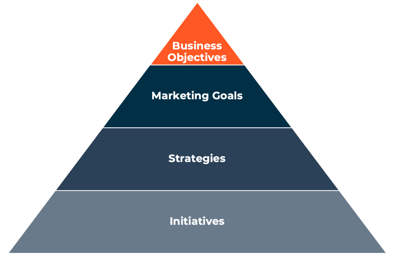
The right approach inverts this. Start with what the business needs. Define the marketing strategy that supports those goals. Then choose channels that fit the strategy. Then select tactics within those channels. Finally, pick tools that enable the tactics.
By approaching your marketing strategy this way, you can directly show how what you're doing ladders back to what the CEO and board ultimately care about. This shifts marketing from an expense to a valuable driver of the business.
The Difference Between Strategy and Tactics

Here's a simple test. Strategy answers "why" and "what." Tactics answer "how."
Strategy: We need to generate qualified leads from mid-market finance teams because they have the highest lifetime value, and our win rate is strongest there.
Tactic: We'll run LinkedIn Sponsored Content targeting CFOs at companies with 500-5,000 employees, promoting our cost reduction calculator.
The tactic only makes sense if you've done the strategy work first. Otherwise, you're just guessing at audiences and offers.
Research from Bain & Company shows that companies with clear strategic planning processes outperform peers by significant margins. Yet in our experience, fewer than half of mid-market companies have documented their marketing strategy in a way that connects to business outcomes.
Strategy Documentation
Your digital marketing strategy should fit on one page. If it takes longer to explain, it's not a strategy. It's a plan. Here's what needs to be on that page:
- Business Objective: The specific outcome marketing supports.
- Target Audience: Who you're trying to reach, and why they should care.
- Value Proposition: What makes you different and better for this audience?
- Channel Priorities: Where you'll focus resources, and where you won't.
- Success Metrics: The 2-3 numbers that tell you if it's working.
- Budget Allocation: How resources map to priorities.
Everything else is execution detail. It may be important, but it’s not a strategy.
Understanding Your Customer Journey
The way people buy has changed. The traditional marketing funnel, where customers move predictably from awareness to consideration to decision, no longer reflects reality.
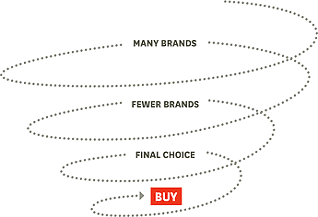
Today's buyers do their own research. They read reviews, ask peers, search Google, check social media, and, increasingly, ask AI assistants for recommendations. By the time they talk to sales or visit your website, many have already made up their minds.
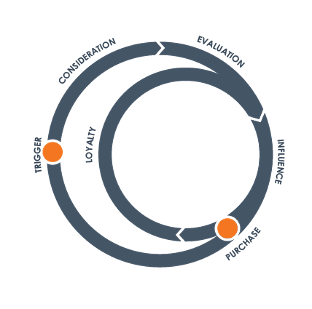 Google's research on the "messy middle" describes this reality. Buyers loop between exploration (expanding their options) and evaluation (narrowing down) multiple times before purchasing. Your marketing needs to show up in both areas.
Mapping the Journey for Your Business
Different channels play different roles at different stages. Brand advertising builds awareness and shapes perceptions before someone knows they need you. Content marketing educates through research. Paid search captures demand when someone is actively looking. Retargeting stays present during the evaluation phase.
| Channel | Trigger | Consideration | Evaluation | Influence | Decision |
This shows which channels serve which journey stages: Awareness (brand advertising, PR, thought leadership), Consideration (content marketing, SEO, social proof), Evaluation, Decision (paid search, retargeting, direct response), Loyalty (email, customer marketing, community).
The challenge is attribution. When someone sees your brand ad, reads your blog 6 months later, clicks a retargeting ad, and then converts by searching for your company name, which channel gets credit?
Traditional last-click attribution would give all credit to the brand search, ignoring everything that built the relationship.
This is why you need both analytics (to track what happened) and incrementality testing (to measure what actually caused the results). More on that in the measurement section.
The AI Disruption of Discovery
Here's what's changing. Buyers are increasingly turning to platforms like ChatGPT, Gemini, and Google's AI Overviews to research solutions to their needs. A 2024 Gartner study projects that traditional search engine volume will decline by 25% by 2026 as users shift to AI-powered alternatives.
Your customer journey map needs to account for this. Where will buyers encounter AI-generated answers about your category? Is your brand appearing in those answers? If not, you have a gap that traditional SEO and advertising can't fill.
But does AI visibility actually matter? Some early research suggests AI tools don't drive significant referral traffic back to websites. That's true; however, we would argue that the value isn't in the click. It's the consideration set. When a buyer asks an AI tool for recommendations, and your competitors show up but you don't, you've lost influence at a critical moment in their journey, whether or not that buyer ever visits your website. Think of it like brand advertising: the ROI isn't measured by immediate clicks. It's measured in whether you're part of the conversation when decisions get made. AI visibility works the same way. Presence matters. Absence is expensive.
Paid Media Strategy That Works
Paid advertising is not a strategy. It's a set of tools that can execute a strategy. The difference here matters.
Too many companies approach paid media by asking "what should we run?" instead of "what are we trying to accomplish?" This leads to fragmented campaigns, wasted spend, and the frustrating situation where every channel looks successful in its own reports (wow, so many impressions!), but the business isn't growing.
When to Use Different Channels
Paid search (Google, Bing) captures existing demand. Someone searching "CRM software for small business" already knows they want a CRM. Paid search puts you in front of them at the moment of intent. This is high-value, but limited. You can't search-capture your way to growth if no one is looking for what you sell.
Social advertising (LinkedIn, Meta, TikTok) creates demand and shapes preferences. People aren't actively shopping, but you can introduce problems and solutions targeted to their profile and interests. This is how you build the pipeline of future demand that paid search will eventually capture.
Programmatic display and video extend reach efficiently. They're best for awareness and retargeting, but less effective for direct response. The targeting is broad, so expect lower conversion rates but broader reach per dollar.
Streaming and connected TV (CTV) offer brand advertising with better targeting than traditional TV. Still expensive, but increasingly accessible for mid-market budgets.
Setting Budgets That Make Sense
Start with your customer economics. What's a customer worth? What can you afford to pay to acquire one? Work backwards from there.
If your average customer is worth $50,000 over their lifetime and your target acquisition cost is 10% of that, you can spend $5,000 to acquire a customer. If your conversion rate is 2%, you need 50 leads per customer, so you can spend $100 per lead.
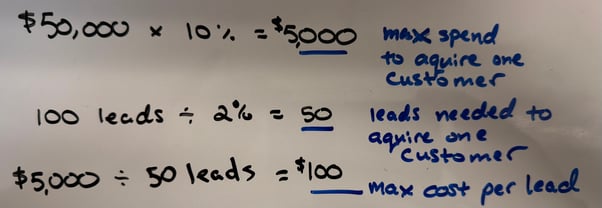
This math should drive budget allocation. Not "what did we spend last year" or "what does the industry benchmark say."
Incrementality: Measuring What Actually Works
Here's the problem with paid media measurement. Your ads get credit for conversions that might have happened anyway. Someone searches for your brand name, clicks your ad, and converts. Did the ad create that sale, or just capture it?
Incrementality testing answers this question. You run controlled experiments where some audiences see your ads and others don't, then measure the difference in outcomes. The lift you see is the true incremental value of your advertising.
We've covered this extensively in Incrementality Experiments: Measuring What Actually Works. [Add Link] The short version: if you're spending significant money on paid media and you haven't tested incrementality, you're probably overestimating your results. And while that conversion may look good on paper, it’s vital to know whether your market spend made the difference or could have been more useful elsewhere. After all, when you REALLY need to focus on conversions, you want to know with confidence which levers to pull.
Organic Strategy: SEO and Content
SEO isn't dead. But it's changing faster than most marketers realize.
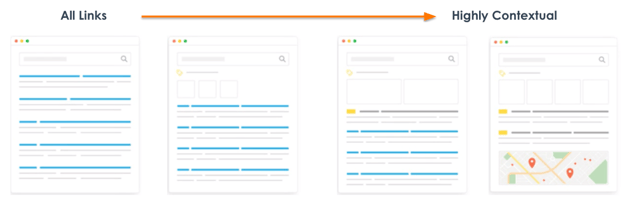
The fundamentals still matter. Technical health, high-quality content, relevant backlinks, and a good user experience. But the goal has shifted. Gone are the days of 10 blue links. The battlefield has gotten more cluttered, and you're now competing to be the source that AI systems cite when they generate answers.
What's Changed and Why It Matters
Google's AI Overviews now appear in a growing percentage of searches, providing direct answers rather than just links. When someone asks, "What's the best CRM for small businesses?" Google might answer directly, sourcing from multiple sites. If you're not one of those sources, you're invisible in that conversation.
We've written about this shift in "How AI Overviews Are Reshaping Search Marketing and Content Strategy." The implications are significant: traffic patterns are changing, click-through rates are shifting, and the content formats that succeed are evolving.
These changes reinforce what became foundational in 2024: Google's integration of helpful content principles into their core algorithm. As we detail in "Understanding Google's Helpful Content Principles in 2026," content created primarily to rank gets penalized while content that genuinely helps users succeeds. Quality and expertise are now non-negotiable for search visibility.
Why Most Content Marketing Fails
Here's the pattern. The company decides they need content. They research keywords. They write articles targeting those keywords. They publish regularly. Traffic grows, but leads don't. The blog becomes a resource that helps people learn, but never connects to business results.
The problem is that this content is created for search engines, not for buyers. It answers questions but doesn't move people toward a decision. It educates but doesn't differentiate.
Effective content marketing works differently. It starts with understanding what your ideal customers need to believe before they'll buy from you. Then it creates content that builds those beliefs. The SEO benefit is secondary to the strategic purpose.
Timeline Expectations
SEO is slow. If anyone promises you results in 30 days, be skeptical. Research on SEO timelines [LINK] shows that meaningful ranking improvements typically take 4-6 months, sometimes longer for competitive terms or new domains.
This has implications for resource allocation. If you need results this quarter, SEO won't deliver them. If you're building for next year and beyond, SEO is one of the highest-ROI channels available.
The AI Search Revolution
Your next customer isn't Googling you. They're asking ChatGPT. That's no hyperbole. We're seeing a fundamental shift in how people find information. Instead of searching and clicking through results, users increasingly ask AI assistants for direct recommendations. Our analysis of this trend shows why this matters for your marketing strategy.
What Is Generative Engine Optimization (GEO)?
GEO is optimizing your content to appear in AI-generated answers. When someone asks ChatGPT, Gemini, or Google's AI Overview for recommendations in your category, will your brand be mentioned?
The factors that influence AI citations are different from those in traditional SEO. AI models take information from multiple sources, weighing authority, specificity, recency, and how well the content directly answers questions. They favor content that states clear positions rather than generic overviews.
%20Key%20Differences%20Table.png?width=560&height=382&name=Traditional%20SEO%20vs%20GEO%20(AI%20Answer%20Engines)%20Key%20Differences%20Table.png)
This shows key differences: SEO optimizes for clicks and rankings; GEO optimizes for citations and mentions. SEO focuses on keywords; GEO focuses on entity recognition and clear signals of expertise. SEO success is measurable through rank tracking; GEO success requires different monitoring approaches.
How to Audit Your AI Visibility
Start with basic queries. Ask ChatGPT and Gemini questions your customers would ask:
- "What are the best options for [your category]?"
- "What should I consider when choosing [your service]?"
- "Who are the leading providers of [what you do]?"
Document whether your brand appears. If it doesn't, that's a problem. If competitors appear and you don't, that's a bigger problem.
One caveat: don't read too much into a single response. AI tools produce different answers every time you ask. If you run the same query multiple times, you'll find different brands in different orders. The question isn't whether you're first in any given answer. It's whether you show up consistently across many queries. Presence in the consideration set matters. Position within a single response does not.
Next, check Google AI Overviews for your key terms. These vary by query, but for informational and research queries in your space, you should see whether Google's AI is citing your content.
What AI Visibility Actually Means
Here's what early data on AI search reveals: ranking position in AI answers is statistically meaningless. The same prompt produces different results every time. But visibility, whether your brand appears in the consideration set, is measurable and meaningful.
Think of it as a binary question: are you in the conversation or not? If competitors consistently appear when buyers ask AI tools for recommendations in your category, and you don't, that's a problem no amount of traditional SEO will fix.
This is fundamentally different from traditional search. In Google, ranking #1 versus #5 has real traffic implications. In AI search, the goal is presence, not position. Either you're part of the answer, or you're invisible.
Be skeptical of any vendor promising precise AI ranking data. Visibility percentage across many queries is meaningful. Position-based metrics are not. The measurement tools in this space are still maturing, so focus on the basics: putting your brand in the best position possible to show up when your category gets mentioned.
What to Do Now
GEO is new enough that there's no established playbook. But some principles are emerging. Clear, direct content that states specific positions performs better than generic advice. Structured data and clear entity signals help AI systems understand what you're about. Authoritative backlinks and citations from trusted sources increase the likelihood of being referenced.
The companies that figure this out early will have a significant advantage. Most of your competitors aren't thinking about it yet.
Marketing Measurement Your CFO Will Actually Believe
Your CFO doesn't care about impressions. They care about revenue, margin, and cash flow.
This is the fundamental disconnect that makes marketing budget conversations so difficult. Marketers speak in metrics that make sense within marketing, like likes, shares, traffic, and leads, but finance thinks in business outcomes. If you can't connect your metrics to theirs, you'll always be fighting for budget.
We wrote about this challenge in depth in "Why Your CFO Doesn't Trust Marketing & How to Fix It." The solution isn't better dashboards. It's a better measurement architecture.
Why Last-Click Attribution Is Broken
Last-click attribution gives all credit to the final touchpoint before conversion. If someone sees your brand ad, reads your content, clicks a retargeting ad, and then searches for your name to convert, last-click says search did all the work.
This obviously misses the full picture. But the alternatives, multi-touch attribution models that distribute credit across touchpoints, have their own problems. They're complex, they require assumptions about how credit should be weighted, and they still can't tell you whether any of those touches were necessary.
The Marketing Science Institute has highlighted how attribution models can overvalue certain channels and undervalue others. The models aren't neutral; they have biases baked in.
The Case for Incrementality Testing
Incrementality testing asks a different question. Instead of "What gets credit for this conversion," it asks, "Would this conversion have happened without this marketing?"
You run experiments. Show ads to one group, not to another. Measure the difference inoutcomes. The gap is the true incremental value.
When we run these tests with clients, we typically find that some channels deliver less value than attribution suggests, while others deliver more. Branded search, for example, often gets credit for conversions that would have happened anyway. Brand advertising often gets too little credit because its effects are indirect and delayed.
Pick the Metrics That Matter
You don't need 47 metrics. You need 2-3 that actually matter.
For most B2B companies, the metrics that matter are qualified pipeline generated and revenue-influenced. For e-commerce, it's often revenue per visitor and customer acquisition cost. For SaaS, trial-to-paid conversion and expansion revenue.
Pick the metrics that connect most directly to business outcomes for your model. Track operational activity metrics but report business metrics to leadership.
Your CFO wants proof that marketing works. Here's how to give them numbers they'll actually believe.
Building Trust With Finance
Here's what actually earns CFO trust:
- Acknowledge the limitations of marketing measurement. Don't claim precision you don't have.
- Run experiments that prove causation, not just correlation.
- Connect your metrics to the financial outcomes they already track.
- Be honest when things aren't working and explain what you're doing about it.
Marketing leaders who do this earn more budget over time. Not because they're better at politics, but because they've demonstrated that marketing spend is an investment with measurable returns, not an expense with uncertain benefits.
Channel Management
Individual channels don't exist in isolation. They work together as a system. Or at least they should.
The problem with treating each channel separately is that you miss the interactions. Brand advertising makes paid search more effective. Content marketing supports social engagement. Email nurturing converts leads generated by other channels. Optimize each piece independently, and you'll miss these connections.
Brand vs. Performance: A False Dichotomy
There's an ongoing debate in marketing about brand building versus performance marketing. We think the debate misses the point. As we wrote in Brand vs. Performance Marketing: How to Align for Growth, the question isn't which one matters. Both do. The question is how to balance them for your specific situation.
Brand marketing builds long-term demand and pricing power. Performance marketing harvests current demand and drives near-term results. Starve the brand, and performance becomes more expensive as you exhaust your audience. Starve performance, and you miss revenue you could capture today.
Research by Les Binet and Peter Field, published in "The Long and the Short of It", suggests that the optimal split for most categories is roughly 60% brand, 40% performance. But this varies by category, competitive situation, and company stage.
For more, check out our branding guide, Building Brands That Matter: A Strategic Framework
Budget Allocation Principles
Start with your customer journey. Where are the biggest gaps? Where are you losing people? Allocate more resources to fill those gaps.
Next, consider channel efficiency. Where are you getting the best returns? Don't just look at last-click metrics. Look at incrementality where you've tested it, and model-based estimates where you haven't.
Finally, factor in strategic priorities. If you're entering a new market, brand investment matters more. If you're defending share, performance efficiency matters more. Let business strategy drive marketing allocation.
Common Multi-Channel Mistakes
Optimizing channels in silos. If your SEO team, paid team, and social team all report independently and optimize for their own metrics, you're leaving money on the table.
Letting channel specialists drive strategy. Agencies and specialists are great at execution, but they see the world through their channel lens. Strategy needs to sit above channels.
Chasing the hot new channel. TikTok might be interesting, but if your buyers aren't there, it doesn't matter how much traffic you get.
Marketing Technology Stack
The martech landscape is overwhelming. Scott Brinker's annual survey now counts over 11,000 marketing technology solutions. Nobody needs 11,000 tools. In fact, we’d argue most companies need fewer than 10.
What You Actually Need
A CRM to track customers and deals. A marketing automation platform for email and lead nurturing. An analytics platform to understand what's happening. An ad platform or two for paid media. A CMS for your website. Maybe a social scheduling tool. That's the core.
Everything else is situational. Do you need a CDP? Maybe if you have complex data integration needs. Do you need an ABM platform? Maybe if you're running sophisticated account-based programs. Do you need AI-powered content tools? Maybe, if you're producing content at scale.
The question isn't whether a tool does something useful. It's whether the value exceeds the cost, including implementation, maintenance, and training. Or, as a former longtime client of ours used to say, “Is the juice worth the squeeze?”
When Companies Buy Too Soon
Here's the pattern. The company sees a demo. The tool looks impressive. Sales rep promises results. The company buys. Six months later, the tool is barely used because they didn't have the process, data, or people to make it work. Before buying any new tool, ask:
- What problem does this solve?
- Do we have the data it needs?
- Do we have the people to run it?
- Do we have the process it plugs into?
If you can't answer all four, wait.
One more consideration: integration. A tool that doesn't connect to your existing stack creates data silos and manual work. We’ve had clients who were paying for Salesforce, but it wasn’t integrated with their other marketing tools. Make sure any new technology plays nicely with what you already have, and that there’s internal buy-in and a plan in place for integration.
Common Digital Marketing Mistakes
After working with dozens of mid-market companies, we see the same mistakes repeatedly. Avoiding these won't guarantee success, but making them usually guarantees failure.
- Optimizing for vanity metrics. Massive amounts of impressions might feel good, but they don't pay bills. If your reports focus on reach and engagement but can't connect to revenue, you're measuring the wrong things.
- Treating channels in isolation. When each channel is optimized independently, you miss out on how channels can support each other. Brand search looks great because brand advertising primed demand, but last-click attribution gives brand search all the credit.
- Not testing anything. Or worse, testing everything without a hypothesis or a plan to make adjustments. Experiments need to answer specific questions. "Let's see what happens" isn't a test; it's a hope. And hope is not a strategy.
- Copying what worked elsewhere. Case studies show what worked for someone else in a specific context. Your context is different. Understand the principles behind the tactic before applying it.
- Ignoring measurement until someone asks. If you don't have a measurement architecture before you start, you'll be guessing when results are due. Build tracking and attribution into campaigns from day one.
- Underestimating timelines. SEO takes months. Brand building takes quarters. Content marketing takes time to compound. If leadership expects results in 30 days, reset expectations, or you're setting yourself up for failure.
- Letting tools drive strategy. We bought HubSpot, so now we need to do inbound. We have Salesforce, so we should run more email campaigns. Tools should support your marketing strategy, not determine it.
A year-end marketing review can help identify which of these mistakes you're making and what to do about them.
Your Digital Marketing Roadmap
If you're building from scratch, here's where to start:
- Clarify business objectives. What does the business need? Growth? Retention? Market expansion? Get specific about the top-down outcomes that marketing should drive.
- Document your strategy. Aim for one page. Identify your target audience, value proposition, channel priorities, success metrics, and budget allocation. If you can't fit that on one page, simplify.
- Map your customer journey. How do people find and buy from you? Where are the gaps? What role should each channel play? How can your marketing support buyers in each stage of the journey?
- Build measurement first. Before launching campaigns, ensure tracking is in place. Analytics, attribution, UTM conventions. You can't optimize what you can't measure. Our UTM parameters guide [LINK] can help.
- Start simple. You don't need to be everywhere at once. Pick 2-3 channels that fit your strategy and get them working before expanding.
If you're already spending money but not seeing results, audit what you have. Review performance data. Test incrementality on major channels. Identify what's actually driving value versus what's just capturing existing demand. Then, reallocate based on what you learn.
The companies that succeed at digital marketing aren't the ones with the biggest budgets or the fanciest tools. They're the ones who build their marketing strategy first, meticulously, and then continuously to improve based on what they learn.